ASOIAF Dragon Lore
Rhaegal
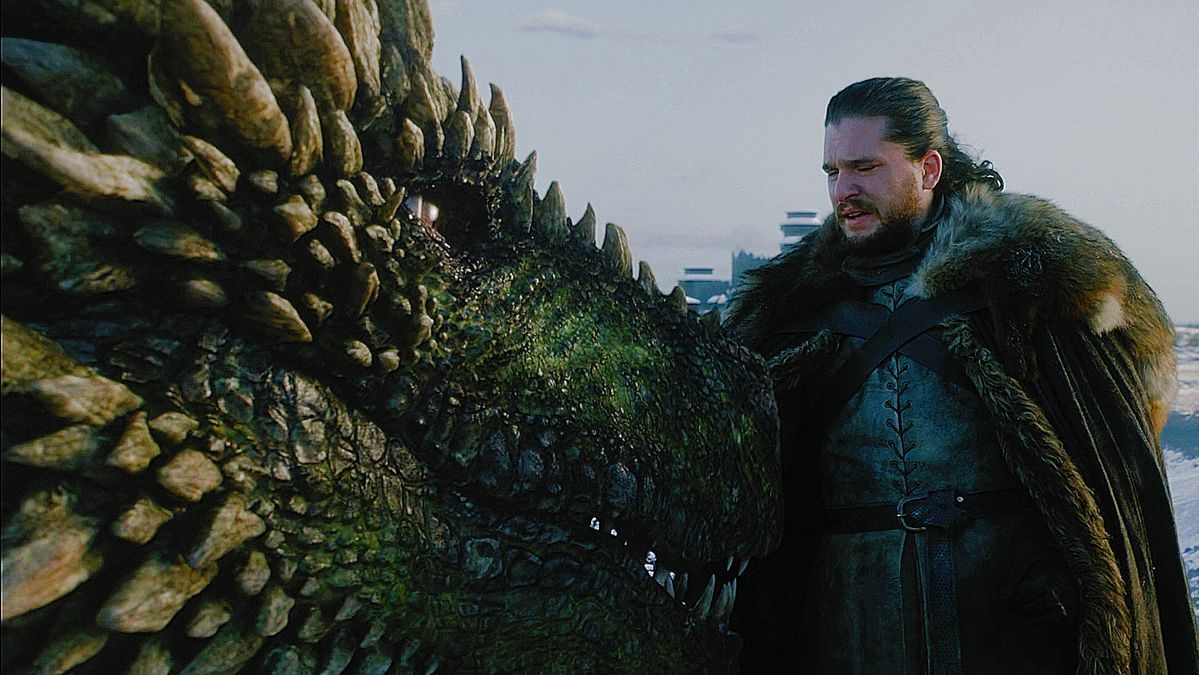
Rhaegal, the green-and-bronze middle dragon of Daenerys Targaryen. Named for Rhaegar, chained beneath Meereen, and deadlier than Viserion when roused.
- Type
- Dragon
- Rider
- None (bonded to Daenerys Targaryen, never formally ridden in canon)
- Hatched
- 298 AC, Dothraki Sea (Khal Drogo’s funeral pyre)
- Status
- Alive (last confirmed in A Dance with Dragons)
- Era
- War of the Five Kings, Slaver’s Bay Campaign
- House
- Targaryen
- Status
- Living
Rhaegal — lore & history
Rhaegal was one of the three dragons hatched in 298 AC on the Dothraki Sea during the funeral pyre of Khal Drogo, alongside Drogon and Viserion. He emerged when Daenerys Targaryen entered the flames with three petrified dragon eggs, marking the first known birth of dragons in over a century. Rhaegal was named in honor of Daenerys’s brother Rhaegar Targaryen, reflecting both lineage and memory within House Targaryen.
Rhaegal was described as having green scales with bronze highlights and wings that shimmered in the light. From his earliest development, he was smaller and less dominant than Drogon, though still capable of independent flight, hunting, and growth at a rapid pace. Like his siblings, he matured quickly during Daenerys’s journey through Essos, increasing in size from a hatchling small enough to perch on her shoulder to a creature large enough to hunt and defend himself.
During Daenerys’s campaign in Slaver’s Bay, Rhaegal remained closely associated with her but was not singled out as her primary mount. As the dragons grew larger and more difficult to control, Daenerys made the decision to confine Rhaegal and Viserion within the Great Pyramid of Meereen following reports of civilian deaths attributed to dragon activity. This marked a significant shift in their role, from symbols of liberation to potential threats within the city.
Rhaegal remained chained in the pyramid for a period, demonstrating increasing agitation and resistance to confinement. He was later freed alongside Viserion when the pyramid was opened during the chaos surrounding Daenerys’s disappearance from Meereen. Following his release, Rhaegal resumed independent flight and hunting, remaining within the region of Meereen rather than ranging as widely as Drogon.
Unlike Drogon, who formed a direct and sustained rider bond with Daenerys, Rhaegal did not become a ridden war dragon during the events of the books. However, his presence contributed to the restoration of dragons as a dominant force in the world, reinforcing the shift in power that accompanied Daenerys’s rise.
Rhaegal is significant as part of the first generation of dragons born after their long extinction in Westeros and Essos. Though less prominent than Drogon in direct combat or symbolic association, he represents the continuation of Targaryen dragon lineage and the broader return of dragonkind. His development, alongside Viserion, demonstrates both the potential and the challenges of controlling dragons in a world that had long forgotten their true nature.
Rhaegal — frequently asked
Did Rhaegal have a rider?
No — Rhaegal had no rider (None — bonded to Daenerys Targaryen but never ridden in the books (prophecy speaks of a third head yet to come).
How big was Rhaegal?
Rhaegal is recorded as a medium dragon. Like his siblings, he matured quickly during Daenerys’s journey through Essos, increasing in size from a hatchling small enough to perch on her shoulder to a creature large enough to hunt and defend himself.
Is Rhaegal still alive?
Yes — Rhaegal is alive as of the current point in the story.
When did Rhaegal live?
Rhaegal belongs to the AGOT Era period of A Song of Ice and Fire history. Associated house: Targaryen.
Is Rhaegal canon?
Yes. Rhaegal appears in George R. R. Martin's published A Song of Ice and Fire works and related material.