ASOIAF Dragon Lore
Viserion
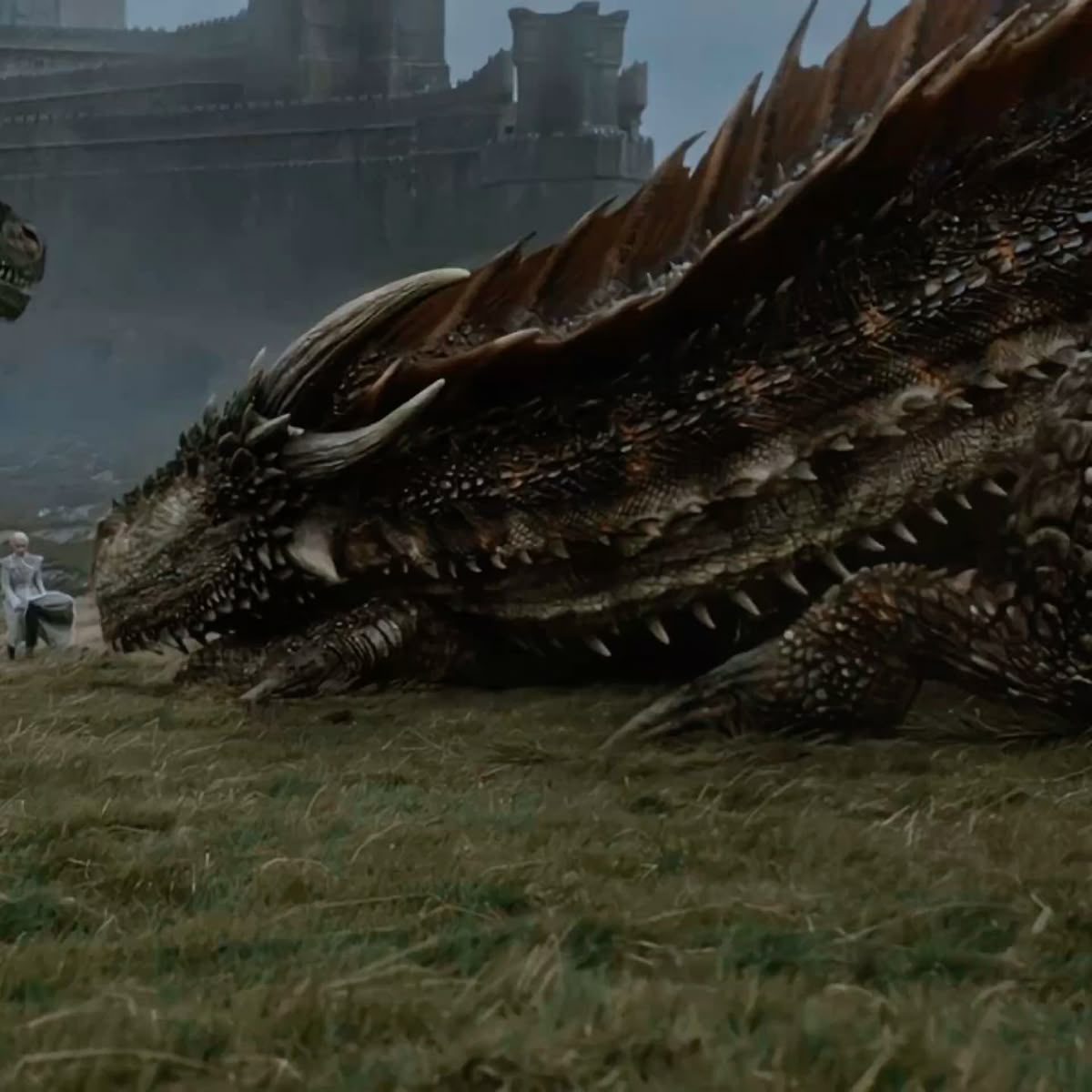
Viserion, the cream-and-gold dragon of Daenerys Targaryen — smallest, gentlest, and the most resourceful of the three when chained beneath Meereen.
- Type
- Dragon
- Rider
- None (bonded to Daenerys Targaryen, never formally ridden in canon)
- Hatched
- 298 AC, Dothraki Sea (Khal Drogo’s funeral pyre)
- Status
- Alive (last confirmed in A Dance with Dragons)
- Era
- War of the Five Kings, Slaver’s Bay Campaign
- House
- Targaryen
- Status
- Living
Viserion — lore & history
Viserion was one of the three dragons hatched in 298 AC on the Dothraki Sea during the funeral pyre of Khal Drogo, alongside Drogon and Rhaegal. His birth marked the return of dragons to the world after more than a century of extinction. He was named after Viserys Targaryen, Daenerys Targaryen’s brother, reflecting both lineage and memory within House Targaryen.
Viserion was described as a cream-and-gold dragon, with pale scales and wings that shone in sunlight. Among the three dragons, he was less dominant than Drogon but more assertive than Rhaegal in certain accounts. Like his siblings, Viserion grew rapidly during Daenerys’s journey through Essos, developing from a hatchling into a dragon capable of independent flight and hunting within a relatively short period.
During Daenerys’s campaign in Slaver’s Bay, Viserion remained closely associated with her but was not used as a primary mount. As the dragons increased in size and became more difficult to control, Daenerys confined Viserion and Rhaegal within the Great Pyramid of Meereen following incidents involving livestock and civilian deaths attributed to dragon activity. This confinement reflected the growing difficulty of managing dragons in an urban environment.
While confined, Viserion showed increasing aggression and resistance, reacting violently to restraint. He was later freed alongside Rhaegal during the unrest that followed Daenerys’s disappearance from Meereen. After his release, Viserion resumed independent movement, remaining in the region rather than ranging as widely as Drogon.
Unlike Drogon, Viserion did not form a direct rider bond during the events of the books and was not deployed in major combat engagements. However, his presence, along with that of Rhaegal, reinforced the re-emergence of dragons as a force in the world. Together, the three dragons restored a form of power that had been absent since the end of the Targaryen dragonline.
Viserion is significant as part of the first generation of dragons born after the extinction of dragons in Westeros. His development reflects both the potential and the limitations of dragons raised outside traditional Valyrian structures of control. Though less prominent than Drogon, Viserion remains an important figure in the re-establishment of dragonkind and the shifting balance of power in the known world.
Viserion — frequently asked
Did Viserion have a rider?
No — Viserion had no rider (None — bonded to Daenerys Targaryen but never ridden in the books (one of the three heads of the dragon yet to fly a rider).
How big was Viserion?
Viserion is recorded as a medium dragon. As the dragons increased in size and became more difficult to control, Daenerys confined Viserion and Rhaegal within the Great Pyramid of Meereen following incidents involving livestock and civilian deaths attributed to dragon activity.
Is Viserion still alive?
Yes — Viserion is alive as of the current point in the story.
When did Viserion live?
Viserion belongs to the AGOT Era period of A Song of Ice and Fire history. Associated house: Targaryen.
Is Viserion canon?
Yes. Viserion appears in George R. R. Martin's published A Song of Ice and Fire works and related material.